
By Benn Farrell, May 30, 2019
Pueblo, Colo. – It has been a long five years for the space vessel Chimera. However, with 80-percent of principle photography in the can, Machinations Entertainment can see a light at the end of the tunnel for what the company aspires to be the pilot episode of a new unique Internet series.
Into the Void, a Web-based video series now in the last leg of production with its pilot episode, seeks to redefine its medium across several genres of motion picture and television. Husband and wife producers Michael and Laura Gates have been dedicated to giving life to the project for the past five years.
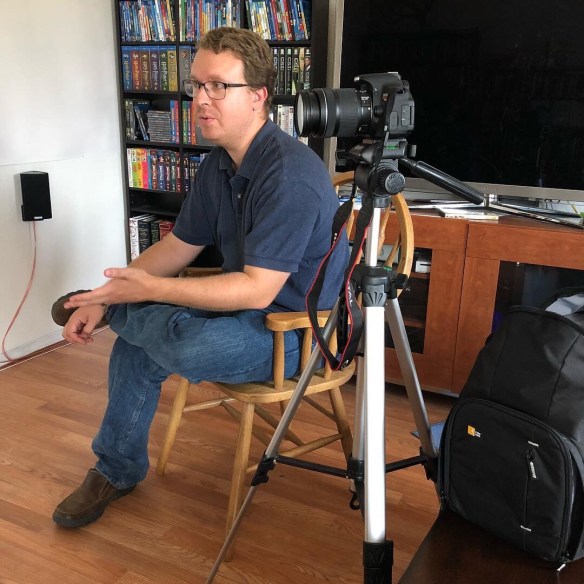
Into the Void writer/director Michael Gates conducts an onscreen audition interview during pre-production of the Web series’ pilot episode. Photo courtesy of Machinations Entertainment
The story of the series, taking place in the year 2641, follows the officers and crewmen of the starship Chimera, a destroyer/escort vessel lead by Lt. Commander Marcus DeVol. DeVol’s family is near ruin, but he aspires to restore his status with his purchased commission running down pirates and blacklisted vessels. However, when he receives a change of orders just before cast-off, DeVol must lead his curious mix of crewmen into certain danger despite them having their own agendas.
At its core, the concept resembles a litter of genres including science fiction, action and character-driven drama. However, creator Michael Gates, who co-wrote the teleplay for the first episode with brother Patrick Gates in Spring 2016, aspires to tweak the concept to give it a fresh take on the genres it wades.
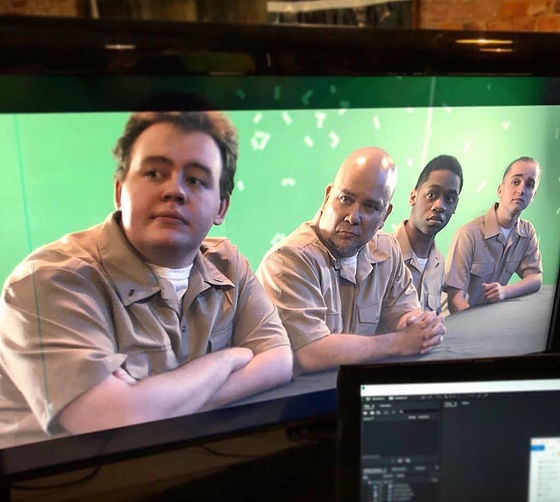
Seen from a monitor during the first week of production, from left, Dylan Tompkins, Brian Nakanishi, Anthony Kelly and Andrew VanDeGrift as supporting cast of Into the Void. Photo courtesy of Machinations Entertainment
Into the Void in its very development steers away from Sci-Fi stereotypes, especially when it comes to a military-style vessel in space. By avoiding stereotypes, the shows creators have added a higher element of danger to its characters. For one, the starship Chimera does not voyage in a universe where shields are a standard option of defense. The starship is just as vulnerable to damage or even destruction from the space equivalent of a torpedo as any submarine in the waters of WWII.
Although space “hop” technology for the Chimera is possible, the use of this notorious tool for Sci-Fi projects of its kind is extremely limited out in the Void. Rather, the show’s concept for the voyage is the same as the 1600s era of British frigates where the ship sets sail for months even years at a time.
Attempting to redefine the action genre, Gates said the concept relies most on suspense and tension rather than traditional action sequences.
“We wanted to strip out as much of the usual magic tech and gimmicks as possible to focus on characters,” Gates said. “As we did that, the aesthetic of the show began to naturally resemble that of a traditional submarine film. Cramped quarters without windows or giant view screens that give you a perfect look at the approaching enemy.”
Although the story involves military-style action sequences, Gates and company has set out to drive the series with its characters’ outer and inner motivations, emphasizing more on characters’ faces rather than gunfire, he said.
The pilot episode of Into the Void itself is independently financed from the husband and wife production team with finishing funds acquired from a crowdfunding campaign completed shortly after casting. Pre-production has taken years as Gates has compiled digital storyboards, sets, lighting and screen tests, creating a pipeline for the production ready for post once principal photography is finished.
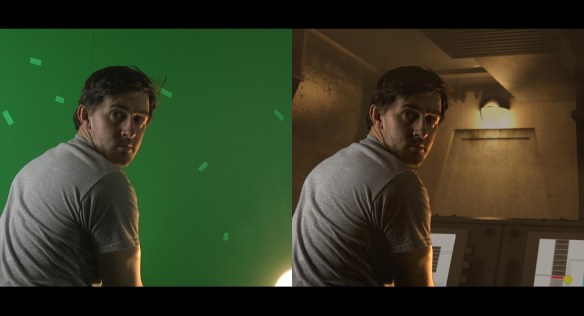
Andrew Comden looks back in a side by side comparison for a shot involving green screen technology during screen tests for Into the Void. Photo courtesy of Machinations Entertainment
Although Gates and company has trudged through many facets of production to their present point, Gates said he has enjoyed watching his cast create their performances over the past few weeks. He considers casting a leap of faith for both actor and filmmaker.
“Watching the cast build their characters and bring them to life is perhaps the most rewarding part of the whole experience,” he said.
Of course no production is without obstacles. For Into the Void’s pilot episode, Gates said scheduling was the most daunting task. A producer has to budget production days wisely in order to make sure there is enough time to get the scene right, he said.
“My original shooting schedule was definitely too ambitious,” Gates said. “Fortunately, we’ve managed to build a cast and crew who are committed to finishing the pilot and making it the best it can possibly be.”
Principal photography for the pilot episode resumes near the middle of June and is anticipated to wrap late June.
For more information on the Into the Void series and updates, visit the production’s Web site at www.ventureintothevoid.com.



 So a bit ago I mentioned I was developing a new stage play and once again my creative process which I write about in this blog has not failed me.
 Benn Farrell, Freelance writing projects and services