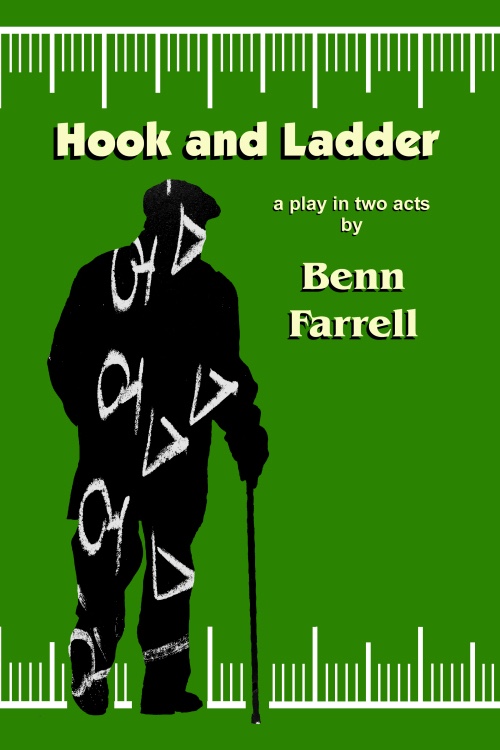
Hook and Ladder actors’ edition now available online!

My latest stageplay titled Hook and Ladder is now available online. I’m terribly excited for this play since it combines my passion for journalism as well as my fanship for football. It also gives me the chance to voice my opinion on a controversial issue and bring awareness to other concerns which may not be generally known by most people (trying not to give spoilers).

Order a copy online and let me know what you think. Add to the conversation. Like, share, whatever! I appreciate everyone’s support as always.

Get your copy here!

Stageplay,theater,theatre,performing,arts,benn,Farrell,drama,football,journalism,cidp,freelance,playwright

About Hook and Ladder:

Hot shot sports writer Dunkin Scott’s career is on the rise as the top reporter at Sports Review Monthly magazine. His readership is at an all-time high and is a frequent guest on major sports radio and television networks.

As if things couldn’t be going better for him, Dunkin is about to get the opportunity of a lifetime when he is assigned to an exclusive interview with future Hall of Fame football linebacker Tony Backlund, the writer’s childhood sports hero.

However, Dunkin soon finds himself pressured by his publisher Rachel Montgomery to spotlight the gridiron great and humanitarian as a fraud because Backlund had taken a knee during the U.S. national anthem at a playoff game six months prior. Quickly, Dunkin finds himself struggling to write what is fair and truthful to his sports hero after he begins to find a disconnect of facts involving Backlund’s abrupt and mysterious retirement as well as his on-field protest.

The play culminates into a mess of journalistic malpractice, unworthy ideology and Dunkin caught at a cross roads to decide what kind of journalist, sports fan and person he wants to be.

Trouble getting started? Begin by writing what is most vivid (UPDATED)

By Benn Farrell – UPDATED: June 8, 2019

You can’t teach an old dog new tricks. That’s a cliche I used to heartily believe, but when it comes to my development of a new stageplay, I find the cliche changes to “You can teach a old dog to do old tricks in a new way.”

When I began developing my latest stageplay, still only in its first draft, I fell back on a technique I developed in college. It still famously works for me, and because of it, I was able to pump out the first draft of Hook and Ladder within six weeks.

With my ghost writing services, I would love to help anyone having trouble getting started with their creative writing project. I’d be honored to help you get the ball rolling, and this technique I have developed to get started can be transposed to writing fiction, non-fiction, stageplays, screenplays, television, etc; possibly even instructional guides. If you feel I can help you get your special creative writing project on paper, visit the Work with Me or the Ghost Writing Services pages of this Web site to learn more and don’t be afraid to reach out.

For now, here is how I am usually able to get started on a new creative project.
Freelance writing services, Content Writer, Copy Writer, Ghost Writing, Playwrighting, Screenwriting, SEO content. All writing services to add a unique value for your publication, Web site and online presence from award winning journalist Benn Farrell.

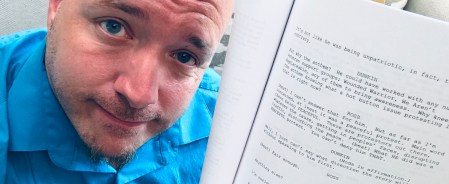
With my ghost writing services, I would love to help you get the first draft of your creative project finally on paper.

When I was in college and aspiring to be a filmmaker, I took a couple of playwriting classes while I was immersed in the performing arts of the school and the community. By then I had already written a handful of screenplays and had my own methods of development, especially ones that were linear given I started on a typewriter and not a laptop like today.

However, when I had finally made the switch to writing my scripts on a laptop, I had learned a key technique in my creative process when developing a new play or screenplay which I still use today. Even after graduating, my former instructors invited me back to workshop their writing classes to share what I had learned and achieved by that point in my writing life.

The technique I had learned, having moved away from the non-linear jail house manner in which writing a screenplay to which a typewriter shackles you, was easy to convey to new students. Every aspiring playwright or screenwriter has a story to tell for the stage or screen. In either of these mediums, usually whoever is writing the play has one, two or several scenes played out in his or her head even before they start writing.

When I was younger, when I had a new play idea, I would take weeks writing the back stories of each major character so I had a firm grasp of their life by the point my story started. After that, it was about actually writing the script. Some stage and screen writers say the two hardest words to write when starting a new project is FADE IN. I agree. It is the hardest task to write the first words of a new play, whether you have done all your background homework or not.

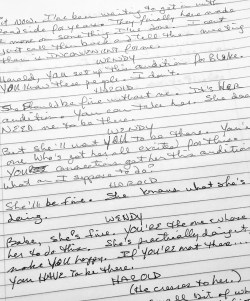
So the technique I decided work best for me to get past this ended up being quite easy. Eventually, I learned to refuse to write the first scene of my script first. Instead, I focused on writing all the vivid, exciting and plot turning scenes I had in my head first. Sometimes, I would end up writing the climax of the entire show as an actual scene on paper. Sometimes I would write the last scene of Act I just so I knew where I would leave my story to have the audience come back from intermission interested in knowing what’s going to happen next.
Freelance writing services, Content Writer, Copy Writer, Ghost Writing, Playwrighting, Screenwriting, SEO content. All writing services to add a unique value for your publication, Web site and online presence from award winning journalist Benn Farrell.

If I had any scene which I could see clearly in my head and know exactly what was going to be conveyed as far as content, that is exactly the scene with which I started to write first. Now these scenes were hardly immaculate, and for the most part they would eventually be re-written several times over as the rest of the script started to come together during my development process. However, those scenes served a key purpose in my script writing process as a whole. Composing the rest of the script around my most vivid scenes made completing the first draft far easier than writing from point A to point B.

Think of it as designing a connect the dots challenge, which we all did when we were kids. You have a series of dots with numbers on them, and the challenge is to use a pencil to start from dot No. 1 and draw a series of lines connecting each dot in the right order until your entire picture is completed. When you’re finished, you’ve actually drawn something. This is now the cornerstone approach I use to writing all my scripts. The scenes which are most vivid in my head are what I write first. All the other scenes between them are simply me connecting the dots with necessary plot points to get to what are ultimately my strongest scenes.

Like I said, those key scenes were usually rewritten, because as I started to get into connecting them I would usually come up with little character tweaks or maybe a new subplot or a beat or two which didn’t exactly connect to my next vivid scene. However, it would improve the dynamic of the story as a whole.

One of the worst things you can do as a writer is have such a huge ego that anything you’ve written prior to your final draft is considered gold. I have written plays which started with what I thought was my strongest scene in the entire show, and by the time I got done with it, going through all my techniques, that first scene I wrote actually became the weakest and I inevitably ended up cutting it from the final draft.

Remember, your final work is a work of art. Art belongs to its audience not to you. If you get to a point where your art is now living on its own, do not make excuses for not cutting material which may have been the cornerstone of the whole thing. That is a move based on ego, not for what’s best for your finished product.

Once again, to get started, right the most vivid scenes that are in your head first. Then to get your first draft finished, all you have to do is play connect the dots.

If you feel I can help you with this technique and would like to have me be your ghost writer for your special project, please reach out and Work with Me so we can discuss how I can assist you with your start today.
Self publish your scripts: Free to you and many benefits

UPDATED: June 7, 2019

There are several web sites on the internet which allows anyone to turn his or her finished manuscript into an actual professional-looking publication. Years ago, I used a service which remain nameless to self publish my works for the stage. However, at some point that service stopped printing books so all the publications I arranged with it were no longer available.

After my mother died, my father in her honor set out to self publish a series of novels she had been writing for years titled The Songbird Series. He looked for online publication services as well and he came up with a couple; Lulu.com being one of them (Lulu.com has not paid me for mentioning their service).

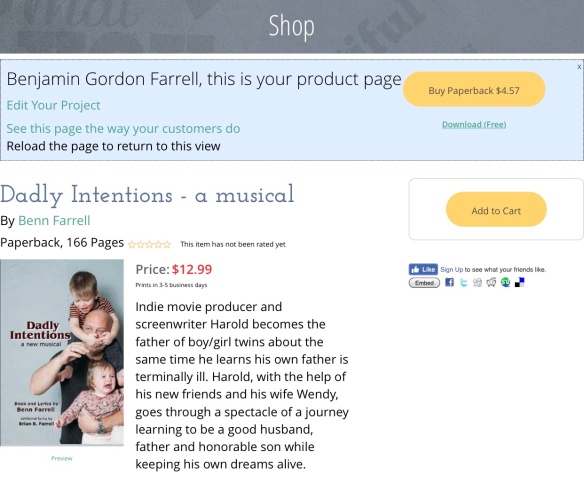
But I when it was time to republish my stage titles, I looked at LuLu and found it offered everything I needed including cross marketing to Amazon and Barnes and Noble with ISBN (that unique barcode thing on the back of the book). So I started republishing my works, updated my prefaces or forwards, reformatted the play for Lulu’s specifications and started going to work.

Freelance writing services, Content Writer, Copy Writer, Ghost Writing, Playwrighting, Screenwriting, SEO content. All writing services to add a unique value for your publication, Web site and online presence from award winning journalist Benn Farrell.

Now my father has a background in graphic design and some of that ability has bled over to me. So when I go to self publish, I do everything from cradle to grave. I reformat my manuscript taking into consideration blank pages behind the title page, the acknowledgements and the preface pages. I also change the page numbering to be at the bottom center position and only noting the Act number and page number (ex. I.3, II.65). I also end up going through the formatting and changing the page breaks, spacing, dialogue and exposition bleeds, etc.

Once I’ve created a new pdf to the new formatting per LuLu’s specifications, their website has you upload the file into your profile for that title. From there it determines how many pages you publishing will be and adjusts the thickness of the cover spine for the next step.

There is a cover tool available in LuLu and other sites, which walk you through creating a front and back cover with available templates. I however like total control of the graphic design, so I download their cover templates and drop them into Photoshop. In Photoshop I create the cover entirely.

Usually when I’m creating a cover, I’ll want some sort of eye catching royalty art. I obtain the images fitting for my covers from sites like shutterstock.com or istockphoto.com. Sometimes I will purchase a couple. With those sites, you can pay for a license to use the image for your publishing. I usually purchase the licenses for images replicated up to 500 times. I figure if one of my scripts hits it big and sells that many copies, then I’ll have generated enough revenue to warranty purchasing a larger license. Luckily, Lulu’s statistics helps you keep a running total of copies purchased and printed so you’ll know when you’re getting close to that limit.

My back covers include the same information. A small paragraph “about the author,” a small quote from a review of my works and my synopsis of that title. I always try to have the synopsis on the publication match the one I’ve written for the same title on my website for consistency, but sometimes space demands me to edit the synopsis down a bit. No harm in that. Just get it to the bones of the story.

If you have issues determining what should be in a synopsis, read my blog about the differences between a Treatment, Synopsis and TV Guide line.

Once my covers are created in Photoshop, I save the work per LuLu specs and upload the final file into LuLu’s cover tool. From there the site has you determine what information that title’s page will provide, then it has you determine the price. It really does a great job walking you through everything so you don’t forget anything.

The best thing about using these sites is, usually and in the case of LuLu, publishing is free. They only make money when you order copies and when you buy copies of your own works, the cost is minimal with discounts for bulk order of 15+ copies. It also asks if you want to mark up the price if someone NOT logged into your account purchases a copy(ies).

Now I don’t publish my non-produced stageplays for the purpose of selling copies. I do this for two main reasons.

One, if a theatre company decides to produce one of my works, I have links on my website for them to purchase copies for their cast readily available. I don’t have to come up with 10-12 copies of the manuscript and have that cost eat into my licensing and royalty revenue. I can simply email a manuscript if they wish and THEY can make as many copies as they want. However, as an actor, I always preferred something smaller to fit in my hand during rehearsals until I was “off book.”

Two, my published plays have a greater impact when I’m sending copies for production consideration than a manuscript. Again, manuscripts are big and bulky sometimes, while my 6″x9″ self published plays are easier to carry and read on the go. Also, with a nice sharp full color glossy cover (which I put together myself using Adobe Photoshop), it helps a producer or whomever visualize my work as having legitimate production value. I’m creating the perception of value.

so if you have a finished work you are submitting for production, think about self publishing online and using the printed publication as a promotional tool. I invite you to look into several publishing sites to figure out which one is the best fit for you.

#selfpublishing #promotionaltools