Originally published May 2009. (Colorado Community Media)
Benn Farrell, Freelance: Sports column
Reply

Originally published May 2009. (Colorado Community Media)
By Benn Farrell, May 30, 2019
Pueblo, Colo. – It has been a long five years for the space vessel Chimera. However, with 80-percent of principle photography in the can, Machinations Entertainment can see a light at the end of the tunnel for what the company aspires to be the pilot episode of a new unique Internet series.
Into the Void, a Web-based video series now in the last leg of production with its pilot episode, seeks to redefine its medium across several genres of motion picture and television. Husband and wife producers Michael and Laura Gates have been dedicated to giving life to the project for the past five years.
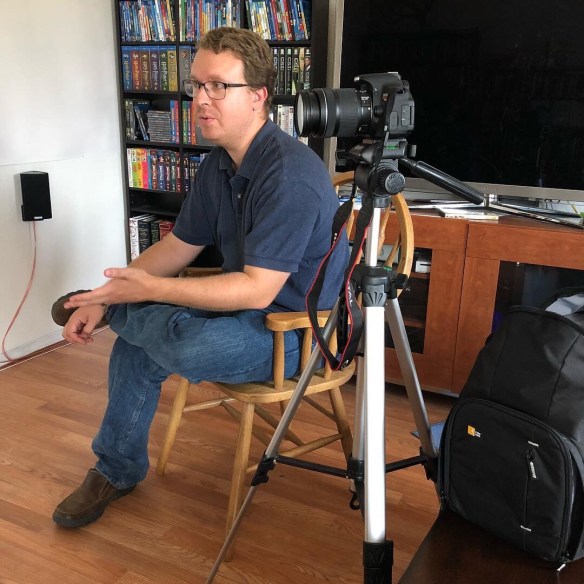
Into the Void writer/director Michael Gates conducts an onscreen audition interview during pre-production of the Web series’ pilot episode. Photo courtesy of Machinations Entertainment
The story of the series, taking place in the year 2641, follows the officers and crewmen of the starship Chimera, a destroyer/escort vessel lead by Lt. Commander Marcus DeVol. DeVol’s family is near ruin, but he aspires to restore his status with his purchased commission running down pirates and blacklisted vessels. However, when he receives a change of orders just before cast-off, DeVol must lead his curious mix of crewmen into certain danger despite them having their own agendas.
At its core, the concept resembles a litter of genres including science fiction, action and character-driven drama. However, creator Michael Gates, who co-wrote the teleplay for the first episode with brother Patrick Gates in Spring 2016, aspires to tweak the concept to give it a fresh take on the genres it wades.
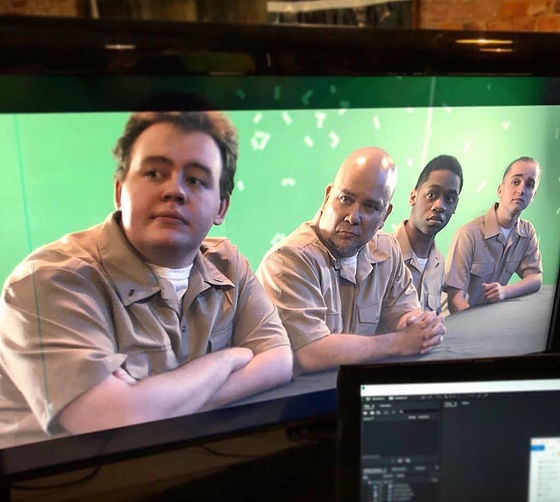
Seen from a monitor during the first week of production, from left, Dylan Tompkins, Brian Nakanishi, Anthony Kelly and Andrew VanDeGrift as supporting cast of Into the Void. Photo courtesy of Machinations Entertainment
Into the Void in its very development steers away from Sci-Fi stereotypes, especially when it comes to a military-style vessel in space. By avoiding stereotypes, the shows creators have added a higher element of danger to its characters. For one, the starship Chimera does not voyage in a universe where shields are a standard option of defense. The starship is just as vulnerable to damage or even destruction from the space equivalent of a torpedo as any submarine in the waters of WWII.
Although space “hop” technology for the Chimera is possible, the use of this notorious tool for Sci-Fi projects of its kind is extremely limited out in the Void. Rather, the show’s concept for the voyage is the same as the 1600s era of British frigates where the ship sets sail for months even years at a time.
Attempting to redefine the action genre, Gates said the concept relies most on suspense and tension rather than traditional action sequences.
“We wanted to strip out as much of the usual magic tech and gimmicks as possible to focus on characters,” Gates said. “As we did that, the aesthetic of the show began to naturally resemble that of a traditional submarine film. Cramped quarters without windows or giant view screens that give you a perfect look at the approaching enemy.”
Although the story involves military-style action sequences, Gates and company has set out to drive the series with its characters’ outer and inner motivations, emphasizing more on characters’ faces rather than gunfire, he said.
The pilot episode of Into the Void itself is independently financed from the husband and wife production team with finishing funds acquired from a crowdfunding campaign completed shortly after casting. Pre-production has taken years as Gates has compiled digital storyboards, sets, lighting and screen tests, creating a pipeline for the production ready for post once principal photography is finished.
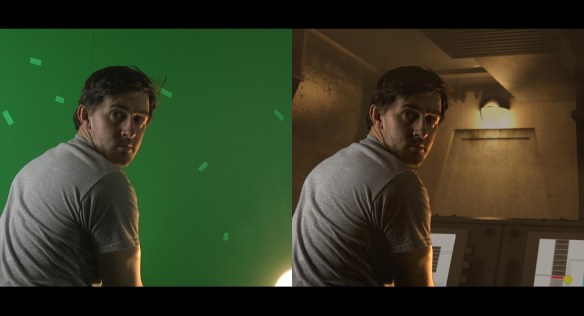
Andrew Comden looks back in a side by side comparison for a shot involving green screen technology during screen tests for Into the Void. Photo courtesy of Machinations Entertainment
Although Gates and company has trudged through many facets of production to their present point, Gates said he has enjoyed watching his cast create their performances over the past few weeks. He considers casting a leap of faith for both actor and filmmaker.
“Watching the cast build their characters and bring them to life is perhaps the most rewarding part of the whole experience,” he said.
Of course no production is without obstacles. For Into the Void’s pilot episode, Gates said scheduling was the most daunting task. A producer has to budget production days wisely in order to make sure there is enough time to get the scene right, he said.
“My original shooting schedule was definitely too ambitious,” Gates said. “Fortunately, we’ve managed to build a cast and crew who are committed to finishing the pilot and making it the best it can possibly be.”
Principal photography for the pilot episode resumes near the middle of June and is anticipated to wrap late June.
For more information on the Into the Void series and updates, visit the production’s Web site at www.ventureintothevoid.com.
Originally published June 2009. (Cooorado Community Media)

Originally published Sept. 2008. (Colorado Community Media)

UPDATED: June 7, 2019
There are several web sites on the internet which allows anyone to turn his or her finished manuscript into an actual professional-looking publication. Years ago, I used a service which remain nameless to self publish my works for the stage. However, at some point that service stopped printing books so all the publications I arranged with it were no longer available.
After my mother died, my father in her honor set out to self publish a series of novels she had been writing for years titled The Songbird Series. He looked for online publication services as well and he came up with a couple; Lulu.com being one of them (Lulu.com has not paid me for mentioning their service).
But I when it was time to republish my stage titles, I looked at LuLu and found it offered everything I needed including cross marketing to Amazon and Barnes and Noble with ISBN (that unique barcode thing on the back of the book). So I started republishing my works, updated my prefaces or forwards, reformatted the play for Lulu’s specifications and started going to work.
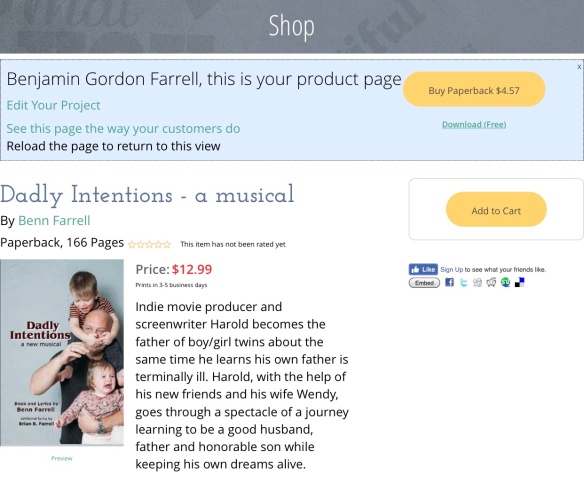
Now my father has a background in graphic design and some of that ability has bled over to me. So when I go to self publish, I do everything from cradle to grave. I reformat my manuscript taking into consideration blank pages behind the title page, the acknowledgements and the preface pages. I also change the page numbering to be at the bottom center position and only noting the Act number and page number (ex. I.3, II.65). I also end up going through the formatting and changing the page breaks, spacing, dialogue and exposition bleeds, etc.
Once I’ve created a new pdf to the new formatting per LuLu’s specifications, their website has you upload the file into your profile for that title. From there it determines how many pages you publishing will be and adjusts the thickness of the cover spine for the next step.
There is a cover tool available in LuLu and other sites, which walk you through creating a front and back cover with available templates. I however like total control of the graphic design, so I download their cover templates and drop them into Photoshop. In Photoshop I create the cover entirely.
Usually when I’m creating a cover, I’ll want some sort of eye catching royalty art. I obtain the images fitting for my covers from sites like shutterstock.com or istockphoto.com. Sometimes I will purchase a couple. With those sites, you can pay for a license to use the image for your publishing. I usually purchase the licenses for images replicated up to 500 times. I figure if one of my scripts hits it big and sells that many copies, then I’ll have generated enough revenue to warranty purchasing a larger license. Luckily, Lulu’s statistics helps you keep a running total of copies purchased and printed so you’ll know when you’re getting close to that limit.
My back covers include the same information. A small paragraph “about the author,” a small quote from a review of my works and my synopsis of that title. I always try to have the synopsis on the publication match the one I’ve written for the same title on my website for consistency, but sometimes space demands me to edit the synopsis down a bit. No harm in that. Just get it to the bones of the story.
If you have issues determining what should be in a synopsis, read my blog about the differences between a Treatment, Synopsis and TV Guide line.
Once my covers are created in Photoshop, I save the work per LuLu specs and upload the final file into LuLu’s cover tool. From there the site has you determine what information that title’s page will provide, then it has you determine the price. It really does a great job walking you through everything so you don’t forget anything.
The best thing about using these sites is, usually and in the case of LuLu, publishing is free. They only make money when you order copies and when you buy copies of your own works, the cost is minimal with discounts for bulk order of 15+ copies. It also asks if you want to mark up the price if someone NOT logged into your account purchases a copy(ies).
Now I don’t publish my non-produced stageplays for the purpose of selling copies. I do this for two main reasons.
One, if a theatre company decides to produce one of my works, I have links on my website for them to purchase copies for their cast readily available. I don’t have to come up with 10-12 copies of the manuscript and have that cost eat into my licensing and royalty revenue. I can simply email a manuscript if they wish and THEY can make as many copies as they want. However, as an actor, I always preferred something smaller to fit in my hand during rehearsals until I was “off book.”
Two, my published plays have a greater impact when I’m sending copies for production consideration than a manuscript. Again, manuscripts are big and bulky sometimes, while my 6″x9″ self published plays are easier to carry and read on the go. Also, with a nice sharp full color glossy cover (which I put together myself using Adobe Photoshop), it helps a producer or whomever visualize my work as having legitimate production value. I’m creating the perception of value.
so if you have a finished work you are submitting for production, think about self publishing online and using the printed publication as a promotional tool. I invite you to look into several publishing sites to figure out which one is the best fit for you.
#selfpublishing #promotionaltools
 Benn Farrell, Freelance writing projects and services