Unknown's avatar

About Benn Farrell

Providing a wide variety of interests from our my company MacDougall-Farrell Services.

A writing app that’s free and works for me

As the technology for writers has developed since I first started writing scripts on a typewriter, it is now possible for you to write a play, screenplay or teleplay from your smart phone. It’s true.

There are a variety of apps in your respective apps stores from which this can be done. There are also apps to help develop your story which could be helpful when you have ideas on the go.

I personally have gone through a couple apps looking for one that works for how I develop and script my ideas and the one on the market which seems a best fit for my style is one simply titled “Playwriter.”
Playwriter allows you to list scenes, characters in development and actually writer the script itself, however I don’t use it to that extent. There are no annoying ads to deal with. The only bad thing is the app does ask you to rate and review it on a regular basis.

What I like about is you can manage many project at the same time from your phone. You can manage multiple characters per project. You can start writing dialogue and scenes and the app will keep track of your locations and number of lines each characters have.
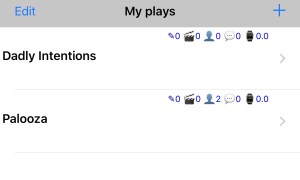
Lastly, as your typing in your scenes, the app keeps track of the total run time of your show.

It also provides an “about” space for the play and characters so you can keep your characters’ backstories in the app as well. I haven’t seen another free app offer that.

Lastly, once you written material into the app, it offers a “Final Draft” button which compiles your material and offers sharing options to email itself. This is key because the app doesn’t exactly offer proper formatting between the different mediums. However, you can email the material to yourself, and the next time you can get to your writing station, you can copy and paste the material and all you have to do is format it in your usual writing program.

There are several other good apps out there which could be a big help to development and writing of your script. Final Draft offers a smart phone version for about $10 and it formats the text for you as you go, which would save you time, but I don’t see an option for it to help if you are writing a stageplay. It seems to only offer screen and teleplay formats.

There is also a free app called Fade In but once again only offers formatting for screen formats not stage. As far as development apps, Everywriter offers some great options for designing an outline for your project as well as character outlines. I don’t usually need these types of development tools but could be handy. That app is also free.

Another great app for screen formats is Celtx. But again if you’re formatting for a stageplay, you could be left in the lurch.

The point is, apps can be an extremely helpful tool for developing and writing your next work from the convenience of your pocket. If you haven’t already, I’d dig into what apps are available in your app store and see what tools would be a best fit for you, just make sure you read the app reviews before downloading. It could save you a ton of work checking each one out for yourself.

Keeping on track: My ball and chain method

Once in college I was writing a stageplay, my first full-length stageplay actually, titled “24 Hours and Something Original.” It was a Spring semester and I was writing the play for myself mostly. However, I was neck deep involved in the theatre company at the college, volunteering as a board member of its governing body.

So of course, I felt if the play was good enough, it may be an option to produce with the company that following summer, since a summer show had not been chosen, nor were they on a regular basis. I wasn’t writing the play very fast. I was definitely taking my time.

However, that had to change after I was having a conversation with the theatre office’s administrative assistant, who was looking for a summer production to use in order to acquire stage management class credit. I mentioned the play I was writing and she asked if she could read what I had so far. Usually I don’t agree to such blasphemy but I decided to let her read the first act, which was finished. I hadn’t started the second act because I honestly didn’t know what direction I wanted to take the story. Back then I didn’t have the development process I do now.

So she read the first act and thought it was worth pitching the idea as the summer production for the theatre group. She put the first half in front of the chair of the department who was in charge of all final green lights. He read it and said he’d want to let us produce it depending on the second act. But I had no second act. The gal who was routing for it said she could stall him a week if I could get her the second half by then. We never told the producer the script was unfinished.

So I had a week to turn out a decent second act, which I figured revisions could be worked out during production rehearsals. That week I didn’t do anything else outside of classes except work on that play. I eventually finished on deadline, which has always been my strength, and the complete play was green-lit for production that summer. This was in 2000.

During that crazy week where my fingers bled typing on my outdated laptop which was given to me as a gift the year before, a fellow community thespian, who also wrote for stage as a hobby, saw me in the halls outside the theater and asked what I was working on. I told him I had a week to finish the script I was on to get it produced. He asked me how I was keeping myself focus to be able to turn out a full act in only seven days.

This brings me to the point of this blog. Focus is sometimes a struggle for writers especially when life gets in the way. My life back then wasn’t much except college and production. However, I still needed to stay focused given my deadline. So I had a method of keeping focused and making sure I continued to spend every free moment on the script and it’s that method I continue to use to this day.

I call my method of focus the Ball and Chain Method, a phrase I used for the first time during that hallway conversation. The Ball and Chain Method is basically using a backpack or a bag to keep on my person at all times with all my notes, drafts, laptop, pens, etc. I feel the weight of that bag on me while I’m going about my day so I am constantly reminded I have work to do…and sits a monkey on my back until it’s finished and I can actually put the backpack down.

Now with the age of smart phones comes new adjustments to the Ball and Chain Method. With calendar and reminder apps, there’s new ways to create yourself the constant annoyances which tell you it’s time to sit down and get work done. Now you can set yourself an actual writing schedule and have your phone, which you would obviously have with you at all times anyways, tell you when it’s time to jump.

There’s also a third avenue to the Ball and Chain Method. If you were a fan of the TV comedy “Friends,” you may remember when Ross was on sabbatical from work and Joey had no new projects so Ross encourages Joey to write his own screenplay in which to star. And Ross would be his wing man to keep him on track, his project while being unemployed. Now that is actually a no shit method. Designating someone to read notes and scenes as they are coming off the printer is a great way to make sure you are producing in a timely fashion.

It would also be beneficial, having been there with my playwrighting classes in college, to have a handful of writers including yourself meeting each week at the same time to pass around what work has been finished from the week prior. That weekly meeting, knowing your cohorts are going to expect you to show with something new each time, gives a negative encouragement to keep producing but at least it’s encouraging and it works. At least it did for me.

The Ball and Chain Method doesn’t work for some. It does for me and has since “24 Hours…” was completed in that week and produced that summer thankfully. But sometimes distraction gets the better of people, I mean OH LOOK A NEW EPISODE OF BIG BANG THEORY…

#ballandchainmethod #focus #stayingontrack #bennfarrellwriter

Double your productivity: Write stageplays which already translate to movies

After I had written my first stageplay, a one-act titled “Snowfight in Providence,” I felt bad I spent that time away from writing more scripts for screen. So when it came time for me to write my idea for a full-length stageplay I had a realization.

Broadway for years before that time and still today always tends to produce shows based on movies, even some of its big budget musicals; Catch Me If You Can, Ground Hog Day, etc. so that got me thinking.

What if I do the opposite? If I were to write stories for the stage which would also translate to a film production, I would double the number of properties I build up over time. So with my first stageplay “24Hours and Something Original” I did exactly that. And that’s what I’ve aimed for with every stageplay I’ve written since.

Every story I’ve conceived since 2000 has either been developed in a way it can be made a screenplay or teleplay with very little rewriting.

I would say the only titles I’ve written which may not translate well is “The Twilight of Nantucket” simply because most of it takes place during Studio record sessions and that limited scope wouldn’t translate well to film. I think it would be a little boring from a visual standpoint. And the other work would be “Dadly Intentions,” my first musical and maybe that’s because I don’t see musicals translating to film to begin with…at least not without some sort of grandiose facade like “Into the Woods” or “The Greatest Showman.” But that’s just me. Everything else I’ve done for stage I feel would also make a good movie, or at least one I would want to see.

In fact, I was talking with my wife recently and we felt after we establish a few goals for this year, one of my plays may be getting turned into a digital motion picture. But I’m not making that official announcement just yet.

So how do I write a stageplay with the intention of is translating to film? There’s no absolute answer for that but here’s a couple things I make sure to do style wise which helps.

1. Any monologues I write for a character can usually be told almost completely with visuals without the character having to say a word.

2. Most of my conceptual set designs are locations which could be obtained by a location scout or relatively easily built in a studio. I don’t make them too lavish for that purpose. Also I don’t want to turn off a potential theatre producer by having huge set requirements.

3. I make sure I add scenes which didn’t happen on the set but referred to outside the material. Like a character saying “The other day I ran into Laurie.” For the screenplay, I’d actually write said scene instead of describing it in dialogue.

4. I don’t let EVERY scene be anchored to the set. Some scenes are casual “get to know ya” type scenes which are developing character. Those scene which do not require the set specifically could be taken out and placed in someplace casual like a coffee shop or race track or anywhere really. Any place which could add scope to a film version.

5. Lastly, I watch the timing of my beats. Beats are bits of the plot or character development which drive the story or development forward. Most movies have a shorter time span between these beats, which usually means a movie version would run faster than the produced stageplay. But when I write a play, it has become my style to try and time my beats the same way a movie would. That way, the material is already timed for a film, for the most part, and require as little adaptation as possible to maintain them.

The differences between a treatment, synopsis and your TV Guide recap

I’ve never written a book so I can’t say what promotional tools you should have to help interest literary agents and/or publishers. However, what I have long found is needed for a playwright or screenwriter to have in his or her pocket after completing a final draft.

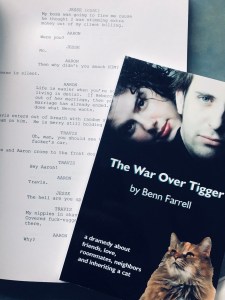
The thing is, when I first started sending out feelers to production companies for possible interest, the hardest part was knowing what each individual company would accept. Some will accept digital submissions of my manuscripts. Some would accept only printed manuscripts. Some just wanted my resume and a web site address.

Soon, I started getting asked for certain promotional items about my works which I didn’t quite understand. I started to hear words like TV Guide line, or recap, Treatment and Synopsis. Obviously I knew was a synopsis was but treatment and guide line I had no clue. And again, some companies wanted a treatment, some just a synopsis and my first two scenes, some just wanted a guide line and for me to wait until they request the manuscript. Nothing was uniform but some things were consistent. Part of those consistencies were the need for me to write a treatment, a synopsis and a guide line for each of my works if I intended to get them produced.

So in case you don’t know either, as I did once upon a time, let me break down the differences between these three promotional tools.

1. Treatment – This is basically a 20-40 page telling of your story with very little dialogue. It’s most commonly requested when you’re pitching a screenplay and it’s probably smart to copyright the treatment as well as our script. A lot of producers I hit up, if I wasn’t turned down immediately, had requested to see a treatment prior to me sending the manuscript. I didn’t run into this very much when promoting a screenplay. However, the next two for stageplays is a must have.

2. Synopsis – This is a one page telling of the basic plot points of your story and what it’s attempting to say or convey. It should let the reader know it’s themes and messages and mention the important of every line speaking character. In the instance of a screenplay, make sure you mention your principal and reflective characters. No need to mention walk on roles specifically unless they bring a huge plot point with them.

3. TV Guide Line, recap or log line – Now since I don’t know anyone who may still remember TV Guide, let me use DirecTV or Dish Network as an example. So you are combing through your satellite TV provider’s guide on your TV screen. You see a movie listed on TMC titled “Roman J Israel, Esq.” You’ve never heard of this movie so you hit the “Info” button on your remote. The screen then provides you a 2-3 sentence guide line of what the movie is about. That’s what people meant when they wanted my TV Guide Line.

So think of these promotional tools as sharing your story in 2-3 sentences (guide line), one page (synopsis) and 30 pages (treatment). And that’s the basic difference.

Believe it or not, I’m far better at whittling a description of my scripts down to 2-3 sentences than I am writing a 30 page treatment. The treatment takes up so much time for me trying to decide what all should go into it. However, a guide line is basically what you would tell someone at a cocktail party who asks, “What’s your new script about?” You only have a few seconds or minute of their time, so a quick recap of your work should be something that comes easily to tell them, and put on paper. The guide line is what you will use in your query letter to get a producer to request the next step of your pitch (the treatment or manuscript or sample pages).

So below is an example of my guide line for my stage play “Fat Farm” found on my “Stageplays” page.

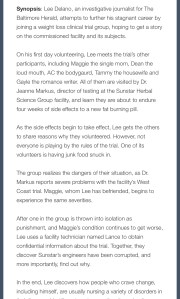
Below is an example of my synopsis for the same play, found on its devoted page.

If I were to get a call from a producer who said “Hey I got your query letter,” (with my guide line. “I’d like you to tell me more but I only have a few minutes,” then the synopsis is what I would tell him.

The treatment I would even write unless someone requests it. But that’s just me. A lot of screenwriters use them as an important piece of their pitch so don’t disclose it. I just haven’t the need for it that much. Usually, from the synopsis, the producers I’ve come in contact with either weren’t interested or wanted the entire manuscript.

Usually the rejections came for silly reasons like I had more characters than what they were looking for, the run time was too long or too short, or the set requirements were too great for their available spaces, etc. What can you do? Some producers or companies are looking for specific material and you may not have a work that is a good fit for them.

On a side note, if you ever do get a response like that with a rejection for one of those reasons, always ask for a referral for a producer or company which may be a good fit for your work. A lot of times, someone who rejects you is willing to help you by letting you drop their name to someone else. And so I don’t forget, theatre producers are far more willing to help than those who solely produce motion picture or television, in my personal experience.

So hopefully, you get an idea of the differences between a treatment, a synopsis and a guide line. All are important and all should be written up and ready to present with as much care as the work itself, especially with you want to end up seeing your work on the stage or screen.

#treatment #synopsis #guideline #recap #logline #promotionaltools #itneverends #bennfarrellwriter