Keep everything you create; you never know when you’ll need it for something bigger

Since I was a teenager, I dabbled in all sorts of creative outlets, from drawing cartoons and an intended comic book, to writing scripts, acting, producing stage and video, writing and performing music…you name it, I pretty much gave it a try at some point.

Over the course of my history, I have created hundreds of works in whatever medium and they have not always seen daylight.  Most of them have been shoved in a drawer or filing cabinet somewhere only for me to dig out when I’m spring cleaning and decide if I need it or not.

Last year, when I was developing my first musical Dadly Intentions, I was starting its process by writing a handful of titles for possible musical numbers.  I figured it would help me with the conceiving my storyline for the show.  As I did so, I was reminded by a friend of a song I wrote and recorded almost 20 years ago.  I called it “Just to Have a Dream,” and the lyrics were about a struggling filmmaker who was in desperate need of focus so he could complete anything creative.

I had completely forgotten about this song, even though I had written several since and even recorded an album, which this song did not appear.  However, I dug the song lyrics out and read them over and instantly I realized it would be perfect for the First Act breakout song to my new musical.  I revamped the lyrics slightly and gave it a new context in its staging and tah-dah, musical number one was completed for my new work.  I hadn’t written a scene yet, but now I knew from where my main character was by the third scene of the show.

The point to this is that anything you have done or plan to do is worth saving.  Even if you don’t show it to anyone, and it’s not coming together the way you had artistically hoped.  Keep it.  You may have a different outlet down the road which may be a perfect fit for it.

Even the title of the musical came from a previous creative endeavor.  While I was neck deep in being a dad to 1-2 year old twins and a daughter two years older then them, I found myself having struggles which I figured I’d start a blog about to see if any other dad’s out there were experiencing similar things.  I also wanted to give mom’s a perspective on what the fathers of their children may be going through in their minds during this journey, allowing them to maybe help stay connected.

I think I wrote one blog, and after two years and no follow up, I shut down the site.  However, I always thought the title was cute, Dadly Intentions.  Obviously this is a play on words from Deadly Intentions, which sounds like some sort of high-budget Hollywood thriller staring Idris Elba.  But Dadly Intentions I thought was cute and memorable, thus when I had the idea for my musical, I knew this title was a perfect fit.  And if you get a chance to read my manuscript for it, I’m certain you’d find the title equally fitting as I do.

As far as keeping creative ideas in a cabinet somewhere, I’ve always done this.  I have a couple of files in my cabinet specifically filled with movie and play ideas I thought of while in college.  Among them was movie idea about a film producer who is in desperate need of finding funding for his latest independent project, so to acquire a name director to the script, he hits up an old mentor who is now in a wheelchair…and now blind.  I thought the idea of a blind movie director was intriguing and possibly hilarious.

However, that’s where I got stuck.  I could develop it enough to decide if I wanted it to be a heavy drama or a situational comedy.  Some years later, even though I kept the idea printed out on a piece of paper and in this file, Woody Allen wrote and directed a movie called Hollywood Ending, in which his character comes down with a case of hysterical blindness while in the middle of directing a big-budget Hollywood feature which could revive his stagnant career.  The movie was hilarious, and I truly felt any idea I fleshed out of my own would only live in the shadow of Woody Allen’s work.  So, that killed that.  But I still have the paper with that idea sitting in my file.  It will never be a full fledged movie, but maybe among those notes there’s a character a can pull from it and use in a different movie or stage script idea.

You never know what your creativity is going to do for you, from you or with you from year to year, so if you create anything, whether it’s a song or a one-paragraph movie idea that will never be fleshed out, hang on to it.  It’s still a part of you and could end up being a part of something bigger and better down the road.
Editing: Mark big, mark lots, mark often

Some say the editing process is where the true mastery of the work is performed.

I tend to see it a different way. For me, the true mastery of creative writing with characters and plot is the work done before the actual writing. For me, it’s the character backstories and back-plot which make or break the quality of what I call finished.

However, obviously the editing process after my first draft is highly important, so here is a quick write up of how I go through it with any of my scripts. I’ve written a post about leaving the first draft in a drawer and not touching it for a month. Let’s assume I’ve already done that. Now I’ve pulled out my first draft and grabbed a handful of colored pencils or pens and a permanent marker to being editing.

I ALWAYS edit my first draft when it’s been printed out on paper. I don’t know why, but for me it’s far easier to catch typos and other major character or plot mistakes or inconsistencies when I see the work on paper. I don’t catch half as many mistakes or needed changes when I’m viewing a PDF copy on my devices. I also keep my printed draft with me almost all the time. Life gets in the way for all artists and creative people. It’s inevitable. My time devoting to this part of the process I perform ANY time I have a spare chunk of time. I’ll work on editing when my kids are in their dance classes. I’ll edit while in the car waiting to pick up my kids from school.

When I’m editing I take an approach to it as if I am being paid by the author to make the script better. When I have my pens out, I mark something on each page. Anything. I’m convinced there’s always something that needs to be corrected on every page whether it’s a spelling or typo error or a line of dialogue that needs changing, added or omitted. If a page doesn’t have a revision mark on it, I missed something. That is my basic approach.

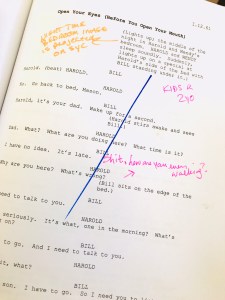
There is also a reason for using different colored pens. I color code my edits depending on what needs to be revised. If I’m editing a stage direction, I’ll use say green to make notes. If it’s a change in dialogue, I’ll use say red. If it’s a revision which ties one part of the script to something in a later or previous scene, I’ll use purple and I’ll noted which page that note is connected to so I know to look for the other scene and match the appropriate changes, also noting the corresponding page number.

By the time I get done editing, the first draft usually looks like a road map legend. Colorful and thoughtful looking, and I am confident my changes have been well processed.

The last step to my editing process and typing in my changes to the original file. However, to make sure I don’t accidentally omit something I should keep when I edit the second draft, I “Save as” the file under the same name with the number of the draft in the file name…so the new file would be “skininthegames2,” for example. Then I have my first draft still in tact to pull material I’d like to re-add if I feel it’s best. Also when I’ve reached my final draft, I know exactly which file to email off for speculation to producers, agents or production companies.

Lastly, when I’m typing in my revisions, I use the permanent marker to put a simple diagonal line through each page I’ve edited as I go and save my work. I don’t think I need to say how important it is to save after every page, because again life gets in the way. I may be typing in edits at home and one of my kids gets hurt or the wife wants to get naked. Knowing I’ve saved the most recent page of edits allows me to simply close the laptop and snap into husband/father mode until the next time I can get back to my work.

The permanent marker slash is strategic. It allows me to know which printed pages have been completed in the new draft and saved without trying to remember of hand. It also allows me to go back to that draft and still be able to read my original draft and revision notes. I’ll keep that draft in a shelf for reference as well as future drafts until I’ve decided the final draft is met, at which point I discard the previous drafts.

That’s my editing process. It works for me. I suggest you find your own process but make it a formal process. Know this part of creative writing is as important as any other part of the process so come up with a formality on which you can rely and know your product is the best it can be.

Your first draft is done! …what next?

So my latest stageplay, my first musical in the works, is completed in its first draft. A lot of aspiring writers I’ve either counseled from writing groups or with whom I’ve taken classes have struggled with the next steps after their initial story gets down on paper.

I’ve had the same struggle several times in my years of play craft and I’ve narrowed down the main cause of this demon. I’ve always wrote. Even before I was a preteen I’ve attempted to put down stories for stage or screen. But it wasn’t until I wrote a short script called The Running, which I later produced on consumer quality VHS video, that I ever wrote something I felt strongly people would enjoy.

After a while, a few scripts later, I thought hard about what made the difference between my crap stinkers and the point I started writing what I deemed readable.

Here’s the answer. Objectivity.

Objectivity is the hardest thing for a writer working on a new project to maintain. When I’m working on a new script, obviously I’m going to be in love with it. If I wasn’t in love with it, I wouldn’t keep working on it. I would put it away until I came up with better ideas for it. So I’m in love with whatever I’m working on, which is the way it should be, until I can call it done.

So my first draft is complete. And that’s when the objectivity has to kick in. Some writers that I’ve worked with have been so in love with their first drafts, they throw it out to producers trying to hook them for a production without ever really stepping back and seeing what they’ve truly put together. And then there are some riders who will actually take the disinterest in their work personally, maybe even forcing them to quit altogether.

Objectivity can save a writer from all of that. So this is what I do to make sure I give myself a chance to give the work it’s best chance. It’s actually a fairly simple process.

1) Finish the first draft. Print the manuscript out, bind it. Write “First Draft” on the cover.

2) (and this is the most important step) LET IT SIT! Let the manuscript sit in a drawer, on a shelf, on the counter next to the coffee maker; I don’t care. Just let it sit. And let it sit for TWO WEEKS AT LEAST. Why? That is the key to objectivity. Forget about what’s in that script. Start developing a new one. If you can start writing vivid scenes of a new project, start to find yourself falling in love with THAT one. Once you’ve gained distance from your first draft, then come back it like an editor not as a writer. There’s a reason why publishing companies, newspapers and whatnot have editors. They are not emotionally attached to your work. They are there to make the work the best it can for the reader. It’s also why big movie production studios hire secondary screenwriters or script doctors.

So give your first draft enough time for you to fall out of love with it. Then go back to it. Find some place that suits you, sit down in disturbed for a while, bring a pen and read your script from start to finish; maybe not in one sitting. For me, I prefer to go somewhere public when I do this for a couple reasons. I make myself focus on the pages. I don’t do this at home so I can stay away from playing the XBox or even working on the project I’ve newly fallen for. The other reason I take this task publicly is when I’m around people, I tend to think about THEM seeing my play or movie and what THEY would need to enjoy it and “get it.”

From there, mark the living crap out of it. Scrutinize like an accountant looking for missing money. Every description, line of dialogue, stage direction. Look for everything and anything that could be deemed confusing; voice, consistent character responses, word choice, angles, everything. For me it’s tenses. I always find mistakes where my stage directions switch from present to past tense and back.

Mark it up and be proud of it. Ask yourself with every scene, “What purpose is this serving the story or character(s) as a whole.” If you can’t find a reason, cut the whole damn scene and don’t look back. Put one big line through those pages and move on.

3) Revisions for the second draft. So now you go back to your laptop or whatever device and edit the manuscript to reflect the changes in your marked up first draft. Maybe you’ll even find new changes in the process. After you’ve plugged in all the changes and cleaned up your formatting accordingly, print it out, write “Second Draft” on the couple and yes, you guessed it, let it sit. Maybe not as long as first draft sat, but some amount of time to regain objectivity yet again.

4) Invite friends over for a reading. After you’ve gained objectivity for the second draft, it’s time to invite a handful of friends to your home, make some food or snacks, offer booze if you can and have them all sit around a table or around the living room to read your second draft out loud. Assign roles to your participants, including someone to read all the stage directions and/or exhibitions. YOU however read NOTHING if you can avoid it. What you do is sit there with a copy of the second draft, with your pen yet again, and make notes. The reason for this step in the process is so you can HEAR you work. Sometimes, especially with dialogue, lines which originally sound good in your head don’t actually sound the same when you hear them out loud. This gives you the chance to hear them and know when lines have to be changed or cut altogether. Same with stage directions. If someone is reading them out loud, and they stumble or get confused on what you’re trying to convey, you’ll know it needs to change maybe to something simpler.

After the reading, ask your readers for feedback. What did they find confusing? What would they like more of? Take their input seriously. This is the first set of people to read and hear your work with the utmost objectivity. They are not emotionally attached to your work. They were there to have a good time and be supportive. If your script sucks by that point, no one would have fun and you’ll know your script’s issue real quick.

5) Plug in your changes from the reading. Take all your notes back to the laptop, make your changes accordingly and when you are done, you’ll have a far more polished script and one that is more ready for the eyes of the general public. This is your third draft if you follow these steps. It may end up being your fourth or fifth draft if you feel you need to repeat steps two and three. You’ll feel it if that’s necessary. Sometimes the steps to my second draft are so extensive, I won’t trust myself that I caught everything. So I’ll go through that part of the process again before feeling it’s time to be read. By the time you schedule your reading, you should feel the script is as objectively edited to the best it can be. After that, at your reading, your simply looking for logistics. You’re looking for the bow on the gift wrapping paper.

Objectivity is key and without it, you can’t guarantee the work is the best you can make it before putting it in front of a producer. The production process will find new ways to change it as well, because staging your script may be a whole different animal than sitting down to read it out loud. But at least you will know you have done your best unemotional job to have your manuscript ready for that next level.

Once I have gone through the steps, I know I’m ready to start drafting my query letter.

Getting Started: writing for the screen at a young age

img_7306I have written valid works for stage and screen–both big and little–since 1993. Valid but on an amateur level. Actually, I wrote my first screenplay when I was 10 years old. I wrote a war movie which didn’t make any sense, and I followed it up with a spy film…also made no sense. My parents were supportive, but they didn’t have a problem telling me how the scripts were utter no-content piles of confusion.So I aspired to do better.
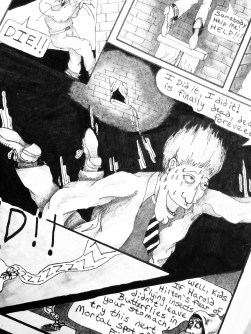
I wrote a comic book–never published and shown to only three people I think–when I was a teenager. Eventually, my mother felt I had a good visual style to telling a story and she suggested I learn to write and direct movies. So off I went.

1993, I wrote, produced, directed and starred in my first shot-on-video movie. It was a short by the title The Running. It was written on a type writer; an actual typewriter. Do you millennials even know what that is? Basically, it’s a contraption for writing which forces you to type entire scenes over again just to add a couple lines of dialogue.

No wonder the movie was only 45 minutes.

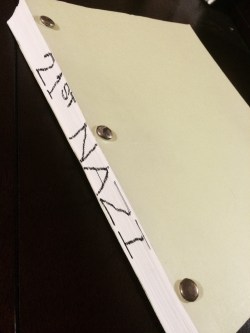
Anyways, it didn’t end there. I produced a handful of other manuscripts with that old technology–if it can even be called that. A couple other screenplays one of which was a three hour epic about a detective attempting to infiltrate a gang of Neo-Nazi’s in Boston. It was called 21st Nazi. It’s terrible. It’s contrived and makes little sense. But at least it’s long!

img_7303I remember the rewrites on that opus. Thanks to the typewriter, rewrites were a pain in the ass for a three hour script. I have such disdain for the entire pile of paper because of that process. But it’s the only three-hour screenplay I’ve ever written, so I kept it and read it from time to time. Just as a word of advice, a shitty script doesn’t get better with age.

Luckily, I promise not to upload any of my terrible “learning” pieces into this blog. All you will find are my credible works for screen and stage, which is where I truly figured out my medium of storytelling. Hopefully, you will agree as I continue to grow as a writer from that 10-year old screenwriter who confused his parents with his work. Sorry, Mom and Dad.