Your characters’ journey may not end with Fade Out

There was a term I learned in filmmaking class called “Intertextualization.” Basically, it’s material from one work which crosses over to another.

The obvious example present day is the Marvel and DC Universe movies where superheroes and villains are used in several titles. A little more subtly is “Forgetting Sarah Marshall” and “Get Him to the Greek,” both of which share one supporting character Aldous Snow, played by Russell Brand. John Wayne as Rooster Cogburn and Paul Newman in “The Hustler” and “The Color of Money” would be another.

The point to me bringing this up is crossing over characters. Sometimes you’ve written something in your past and presently you may be stuck for a new idea. Sometimes that new idea can come to you by digging out a previous character and extending their own story.

When I was mostly writing screenplays, I wrote one work called “Whitebred.” The main character’s boyfriend was a chap named Denny, and I took Denny’s story into his own movie which I called “Wonderbred.” Since his group of friends was the same as those in Whitebred, all my character development was built in and away I went with a new work.

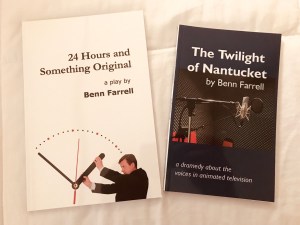
When I started the switch to stageplays, I wrote a script called “24 Hours and Something Original.” A couple years later, I came up with a play solely because I wanted to write a story which took place in a recording studio. I was having trouble devising a plot however.

So I once again dig through things I’d already written looking for a couple characters to spark a story for my recording studio setting. I eventually figured Dennis, my young creator of the animated TV show Nantucket from my “24 Hours…” script, who continues his story into what I titled “The Twilight of Nantucket,” which centered around the voiceless talent of the TV show and Dennis makes his new appearance at the end where he gets to stick it to my villain executive character, also from “24 Hours…”

Now to be honest, I’m not exactly certain “The Twilight of Nantucket” is as good a play as “24 Hours…”. However, I am confident that the later show does stand on its own. Meaning, a reader or audience member wouldn’t need to have seen “24 Hours…” to understand what’s going on in “The Twilight of Nantucket.” And at least those two characters from the first story helped fuel my idea for the second story, even though they are only a part of the climax.

So if you ever get stuck when developing a new idea, try dusting off characters you’ve already developed for other works and see where they may fit. Some times new characters need a little mentoring and can spark plot points to extended the life of people you’ve already invented.

Life shouldn’t get in the way of writing; it should be the inspiration

It may be hard for some authors to continue developing and writing new work, especially when it’s not yet a full time job.

The phrase that always coins the persistent stop and go from my own projects is “Life gets in the way.” That is but the simple truth. Life for me means marriage, a good paying business which takes up much of my time seven months out of the year and of course my three children. There are always honey-do’s, daddy-won’t-you-please’s and sales calls to be completed with the utmost importance when they come up. So if I am neck deep in the middle of a scene or typing up a draft of my latest work, it doesn’t matter. Life and my responsibility in it takes precedence until I can come back to my creative time.

However, what I’ve managed to learn is my life may get in the way, but it only now fuels the material from which I draw for characters, dialogue, plot points, etc.

My most recent example is my project Dadly Intentions, which I first started developing and inking June of last year. I found myself very inspired at that time to write my first musical, and of course I needed a story idea. This also came shortly after my father told me he had cancer and was terminal with three to six months to live (he made it to eight). At the same time, my boy/girl twins just exited the terrible three’s in fine fashion and my six year old just completed Kindergarten and going on her sophomore year of college given how sharp she was. And lastly, I am always trying to not let life get in the way of being a good husband and showing my appreciation for my wife.

What’s more, I was in the upslope of my prime season of my “paying gig” so finding time to pen a new play, a musical no less, didn’t seem possible. However, I managed to have my first draft finished with all lyrics within four months including my usual weeks of development and planning.

The reason was my story idea ended up being about a struggling screenwriter/producer who becomes a new father to boy/girl twins about the same time he learns his father is dying. So my musical is basically about a man who goes on a journey to learn to be a good husband, father and honorable son while not giving up on his own dreams. Sounds familiar, right? The stars aligned between my creative inspiration and my life inspiration and because of that I had so much material with which to express myself.

And to be honest, writing that play serves as a sort of therapeutic outlet during such an intense time. In turn, I whole heartedly feel Dadly Intentions is my most personal creative work since my stage play Mourning News.

I’ve read several times over Woody Allen tends to take bits of his personal life and uses them as the muse of his writing. Not that I would be so presumptive to compare my quality of writing to that of Woody Allen, but I will say the older I get and the more “life” I end up having, the more I can start to relate to how Allen uses life’s natural plot points as his creative ones. It really does help far more creative work which feels human and relatable if you can take life getting in way and using it to fuel your writing, at least for me it does.

By the way, if Allen’s works are always inspired by his personal life, than given certain consistencies in his material, his life must involve psychotherapists, hookers and jazz music almost every day. Just an observation.

Anyways, next time your trying to crank out a written work and life suddenly gives you a curve ball, think of your situation and how it can help your writing instead of prevent you from doing it.

The time I got to put an adapted screenplay literally in Clive Barker’s hands

So when I was younger and decided I was going to attempt to learn filmmaking, I had dabbled in learning to properly adapt a work of fiction not originally written for the screen. One particular work I longed to adapt into at least a short form movie was a story called The Body Politic written in a series of collection books by Clive Barker titles The Books of Blood.

I was into horror movies back then, but I loved the more mental component of Barker’s work not just his radical imagination mixing horror and fantasy.

The Body Politic was a small story of how everyone’s body parts had a mind of their own and everyone’s hands decided to organize and execute a bloody revolution, severing themselves from their masters.

So I wrote the screenplay for Barker’s story simply for myself as a learning tool. And I did figure I would eventually attempt to shoot the movie with a low budget on video at some point as a learning experience as well. However, for about two years, my script collected dust, that is until I received an email from the Clive Barker fan club.

The email was a flash announcement to Colorado’s chapter members stating Clive Barker would be doing a surprise autograph signing at the Tattered Cover in Denver. There was only 24 hours notice of the event and fortunately I was able to rearrange some things to make sure I got to meet one of my favorite authors at the time.

Although I wanted to of course have Barker sign his latest hardcover release, Sacrament, which I went out and bought for the occasion, the email announcement also stated he would be willing to sign one other item of each fan’s choosing. I had him sign a copy of my favorite book from him, Cabal, which was made into the movie Nightbreed in 1990.

However, in addition, I knew this moment was also an opportunity for me to actually put one of my screenplays in the hands of the man who inspired it. Yes, I had a small day dream of Barker reading the script and deciding it was so good he would want to produce it himself, he would both win Emmy awards, we’d be best friends for life, yadda, yadda… you know how day dreams go. But moreso, I just wanted to show Barker I was a big fan enough to write a screenplay for my favorite short story of his just for the hell of it.

So I took my brother with me for the sole purpose of having him take photos of my while meeting Clive Barker. I don’t exactly remember how long we stood in line, but the wait alone was testament to the effectiveness of the Colorado chapter of the Clive Barker Fan Club email list. It was impressive that in only 24 hours from announcement, the turn out went out the door of the store, then inside and up the stairs and back down the stairs to Barker’s table on the other side.

What was worse, Barker was a nice enough author to take as much time with everyone as he needed. This made the event feel like an all day thing but it also ran my chance of meeting Barker and handing him my script very close to closing time. Fortunately, I got there early enough to be in front of the Master of the Macabre an hour before his event was over.

The moment was so long ago. I can barely remember any real details and thank god I had my brother take pictures. If he hadn’t, I may not remember Clive Barker at all except for his autograph on my books. However, here is what I do remember…

It was my birthday the day I met him. I know this because Barker actually wrote a happy birthday note to me in my copy of Sacrament.

He suggested we get a birthday beer after the event. I remember this because with the release of Sacrament, Clive Barker officially came out of the closet as a homosexual. So given this, I wondered if him suggesting to get a beer was some way of him hitting on me. Of course, at the time, I hadn’t any homosexual friends, at least none I knew of or at least out of the closet, so I didn’t exactly have an understanding of what it was like to be flattered by someone of the same sex. Nor did I know what it was like to be flattered by a celebrity.
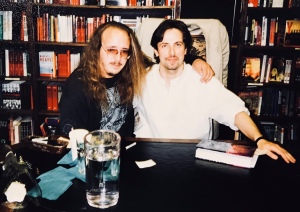
Clive Barker was just being a nice fellow trying to amuse a fan. In hindsight, I know he wasn’t series about going for a beer after. He was trying to be friendly. It’s kind of like that thing where to tell someone you casually just met, “Hey let’s get together and have dinner sometime,” and then neither of you ever call the other because the intent was never really there in the first place. That was my beer with Clive Barker…except I was a young retarded fanboy…and he was the creator of the character Pinhead.

Now I can’t exactly tell you what his reaction was to my presenting him my Body Politic Adaptation and of you look at the photo of me shaking hands with him, there appears to be something tied up WITH the manuscript. I couldn’t tell you what that was either. It may have been a VHS copy of one of my movies, but I hope to god it wasn’t since most of the projects I produced and directed by that time were less cinematically impressive than cat vomit. Regardless, I do remember he was willing to accept my gift. He was like I said friendly and appreciative of my fanship.

I also remember feeling genuinely happy for Barker. I can imagine coming out is never easy at any age and can’t be much easier for a celebrity. But he definitely had a spark about him I hadn’t seen in interviews with him before and I got the sense it was his coming out and acceptance of so many fans which seemed to put a smile on his face that day. Maybe I’m wrong. I don’t know. He was a happy guy though. That was for sure.

The end of my story is unfortunately not one of achievement or even excitement. Not only did I never hear from Clive Barker or his people about how amazing my adaptation screenplay was, years later I read a production company bought The Body Politic’s film rights intended to become a TV mini series. To this day, I can’t find any evidence of that project actually getting off the ground but regardless, I won’t be the credited screenwriter or director if it ever does.

Regardless, I did get to meet Clive Barker in person and I did manage to put a piece of my own writing in his hands in homage of my fanship towards the creator of Hellraiser.
Playwrighting: set design for visualization

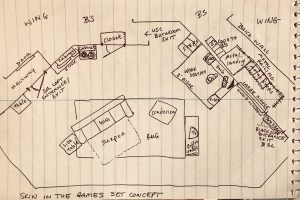
For me, the first step in visualizing a new stage play I’m about to write would be designing the set.

If anyone reads any of my blogs, they know I am huge on visualization of what I’m about to write and proper development of my material prior to writing my first scene. Again, for me, I have to figure out the best layout to tell my story even before I’ve determined how many speaking characters I actually need.

When I’m putting a conceptual set together, there are mostly three things I consider.

1. Space – I never intend to limit the amount of production companies I can submit my work for consideration and an easy way to do that is to make the set requires so grand, a technical director would have a nightmare trying to fit it into a space which would normally be suitable with a few adjustments. I want the play to read easy to produce from a technical standpoint.

2. Blocking – I never want to create a setting which is so complex I’ll confuse myself when making blocking suggestions in the script. Nor do I want my prospective producer to eat confused either. So I make my sets fairly easy in which characters can move around.

3. Description – I lastly want to make sure my set descriptions, which are always described in the first pages of my manuscripts, are easy to describe in the first place. Usually I don’t include a scan of my conceptual set design, so it’s up to me as the author to describe the set with words solely and if I can’t convey the requirements for the story without confusing the reader, than obviously changes need to be made.

These three considerations are usually what I cling to putting my conceptual set design together. And if I’ve done right by myself, I usually have no problems with that aspect of writing the play itself.

Visualizing tool: The Morgue

I have always said the more preparation you do when developing your script or novel, if that’s your chosen vehicle, the less work you’ll have to do when it’s time to actually write it.  Anything you can do to pre-determine the life and adversity of your characters, their inner motivations and conflicts, etc. will ALWAYS help an author stay focused on his or her voice when the actual writing begins.

Not every one, however, has the ability to develop and pre-plan their work.  For some people, they are more comfortable simply deciding character names and jumping into the first scene or chapter.  Doing that actually makes me break out in hives.  I remember my youthful days when I started writing stories, that’s how I would get started.  The result would be some of my worst and most immature, from a construction stand point, works ever.

My favorite example of an author who knew the importance of development and preparation of a new work is Agatha Christie (Murder On the Orient Express, Death On the Nile).  Christie described much of her process in an autobiography and noted her process over arguably her most popular work, “Ten Little Indians,” originally titled “Ten Little Niggers,” which was re-named for obvious offensive reasons. The book has now been re-titled “And Then There Were None,” because the mention of Indians in the previous title has also become offensive among present-day American culture.

“I wrote the book after a tremendous amount of planning,” Christie said about that work. “It was clear, straight forward, baffling, and yet had an epilogue in order to explain it.

“It was well received and reviewed, but the person  who was really pleased with it was myself, for I knew better than any critic how difficult it had been.”

She knew the work prior to writing was deeply important, but it was most important to her before any reader or critic.  My early failures due to a lack of preparation did however serve a purpose.

Those early works helped create what is my process today.  I have also come to realize the biggest reason why I rely on all my preparation.  The key for me is visualization.  Visualization refers to an author’s ability to see their work being “acted” out.  Whether its a movie, stageplay or novel, I’m convinced every author must actually see the “scenes,” places and people described and interacting with each other in their minds prior or as it is being written.  Some authors have no struggle with this and it comes as natural as breathing.

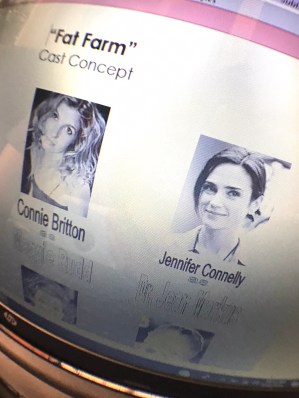
For me, it’s usually easy to see my strongest scenes acted out in my mind.  However, occasionally I get stuck.  So again, I devised a step in my development process which helps me make sure I don’t have issues visualizing my work as I’m writing it.  Although I have several steps which I will probably post about down the road, this step is what I refer to as The Morgue, or what I used to call a “Cast Concept.”

In The Morgue, what I’m actually doing is casting the production or movie in my head with whomever actor or actress I feel best matches the character in my head.  Those actors usually have a style all their own, and it helps me find patterns for the way my characters speak, knowing who will be playing them.

When I’m casting, I’m combing Google or images of celebrity actors whom are the same age range of my characters.  I find headshots of them and I take them from the web and put them in a Word file with the character’s name.  When The Morgue is done, I have a visual spreadsheet of the faces of my new play or movie.  I only cast the single speaking roles.  I do not bother with faces of The Company, if one of my shows have one like my musical “Dadly Intentions.”  If one of my roles is the only role an actor in that show is devoted to playing, then I cast it.  Otherwise, I don’t bother.

This usually helps me if I get stuck with a scene of multiple characters.  If the conversation is overlapped and lengthy, I use The Morgue I created to visually see everyone talking in my head.  It’s a simple tool to keep me focused, and putting The Morgue together in the first place is an incredibly fun activity for me which helps me get excited for actually writing my newest project.

I have several other visualization tools which I use but none of the others are a permanent staple of my development process as The Morgue, with the exception of designing a conceptual set.  That is a must for me as well.  When I was working on Fat Farm, I found myself getting lost in some scene with so many characters moving around the commons area.  I started to lose track of where everyone was, so I actually drew out a scale layout of my conceptual set design and I took a small amount of toy Army soldiers and taped little flags to their backs with the names of my characters written on them.

Then as I was writing the most technical scenes, I used the action figures to keep track of where I last physically put characters within a scene.  Basically, I was staging the scene with the action figures as I was writing it.  It slowed down the actual writing of the play, but it saved me hours in the editing process, having to correct the conceptual blocking in later drafts.

Anyways, I feel visualization of your work is a key component to making the actual work flow as easily and with the upmost quality as possible.  I’ve been stuck on a work of writing so many times, I couldn’t even count them or even remember ALL the reasons why, but what I have been able to do is figure out a solution to prevent it from happening again.  I suggest you figure out yours, and since it’s a lot of fun anyways, give The Morgue a try on your next project.